




A Homecoming to Culture, Identity and the Spirit of Iteso Unity
“This hate spirit was vanquished by the love spirit of Iteso.”
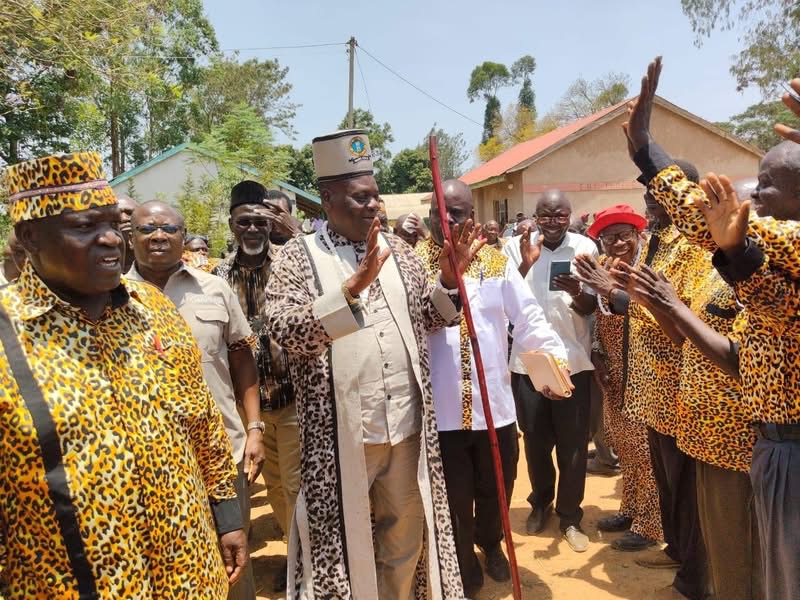
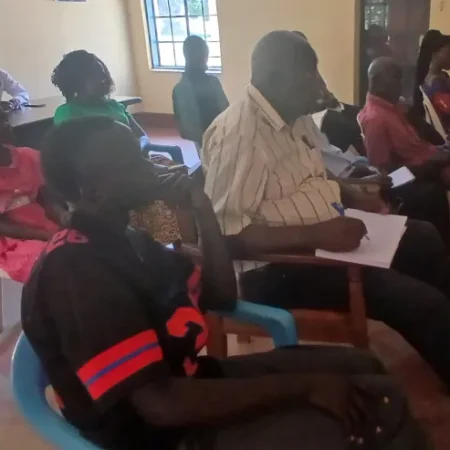
The visit of His Royal Highness Paul Sande Etomeileng Emolot, Emorimor Papa Iteso III, to the Iteso community of Nambale, Kenya, marks an important moment in the continuing journey of Iteso cultural renewal, identity and unity.
For generations, the Iteso of Nambale have lived alongside their Luhya neighbours in a relationship shaped by proximity, interaction, intermarriage, trade and shared community life. Throughout this history, the Iteso have largely maintained their characteristic spirit of accommodation, resilience and peaceful coexistence.
Yet, as with many communities living away from their ancestral homeland, cultural assimilation has presented its own challenges.
The gradual weakening of the Ateso language, Iteso names, traditional practices, foods, customs and cultural knowledge has created a concern that cannot simply be ignored.
The visit of the Emorimor has therefore come at a significant moment.
- It is a reminder that cultural identity can be renewed.
- It is a reminder that language can be revived.
- It is a reminder that names can be reclaimed.
And above all, it is a reminder that an Iteso community does not cease to be Iteso simply because it lives beyond the borders of Uganda.
⸻
A PROMISE MADE AT CORONATION
When His Royal Highness was installed as Emorimor Papa Iteso III on 22 October 2022, he made a solemn commitment to reach out to every Etesot and Atesot, wherever they may be found.
- That promise transcended geography.
- It was a commitment to the people.
- It was a commitment to the preservation of Iteso identity.
- And it was a commitment to ensure that no Iteso community would be forgotten simply because it had settled far from the traditional heartland of Teso.
The Emorimor’s visit to Nambale is therefore not merely a royal courtesy call.
- It is the fulfilment of a promise.
- It demonstrates that the institution of the Emorimor recognises the Iteso wherever they live and regards every Iteso community as part of one cultural family.
From Nambale to Kitale, from Trans Nzoia to Kakamega, and ultimately wherever the Iteso have established communities, the message is clear:
Wherever an Iteso is found, there is a cultural home to be remembered, respected and strengthened.
⸻
NAMBALE: A COMMUNITY RECONNECTING WITH ITS ROOTS
The Iteso of Nambale have lived among their Luhya neighbours for many years.
Their history demonstrates that cultural identity and peaceful coexistence can exist together.
The objective of cultural renewal is therefore not to create hostility between communities.
- It is not to reject neighbours.
- It is not to rewrite shared histories.
- It is not to create new divisions.
Rather, it is to ensure that the Iteso themselves do not lose the cultural inheritance handed down to them by previous generations.
The renewed cultural consciousness in Nambale is about reconnecting with:
- Ateso — our language.
- Iteso names — our identity.
- Our traditional foods — our heritage.
- Our ceremonies — our memory.
- Our customs — our values.
- Our history — our foundation.
- Our children — our future.
The Iteso can proudly reclaim their culture while continuing to live peacefully and respectfully with their Luhya neighbours and all other communities.
That is the essence of cultural confidence.
⸻
THE CULTURAL AWAKENING
What is happening in Nambale is part of a broader cultural awakening.
Across communities outside the traditional centre of Teso, Iteso families are increasingly recognising the importance of transmitting their heritage to younger generations.
This is particularly important at a time when globalisation, urbanisation, intermarriage and modern communication are rapidly changing the way communities preserve identity.
Cultural preservation cannot depend solely on geography.
- It must happen in homes.
- It must happen in families.
- It must happen in schools and community gatherings.
- It must happen through language.
- It must happen through storytelling.
And it must happen through the conscious decision of parents and elders to teach younger generations where they come from.
The Emorimor’s outreach provides an important institutional connection to that process.
⸻
FROM KITale AND TRANS NZOIA TO KAKAMEGA
The Emorimor’s cultural outreach in Kenya does not end with Nambale.
His Royal Highness has already extended his engagement to Kitale and Trans Nzoia, reaching communities that have maintained their Iteso identity despite living outside Uganda.
The journey now looks towards Kakamega and other areas where Iteso communities continue to live.
This outreach reflects a simple principle:
- No Iteso community should feel forgotten.
- The cultural map of the Iteso people is therefore larger than a single geographical location.
- It includes communities in Uganda, Kenya and the wider region, as well as Iteso living in the Diaspora.
Wherever they are found, the connection to their heritage can be strengthened.
⸻
THE EXODUS: A METAPHOR FOR CULTURAL LIBERATION
For many Iteso, the present cultural awakening can be understood through the powerful biblical metaphor of the Exodus.
The story of Moses leading the Israelites out of Egypt represents liberation, identity, faith and the journey towards a new beginning.
In a similar symbolic sense, the renewed cultural movement among the Iteso of Nambale represents a peaceful journey away from cultural erosion and towards renewed identity.
- The destination is not necessarily a physical territory.
- The destination is cultural belonging.
- It is the ability to speak Ateso without embarrassment.
- To carry an Iteso name with pride.
- To prepare traditional food.
- To teach children traditional values.
- To remember ancestral histories.
- To celebrate cultural ceremonies.
And to understand that one’s cultural identity is not something that must be surrendered in order to coexist with others.
This is an Exodus of identity — not a journey against our neighbours.
⸻
“GO BACK TO SOROTI”
For generations, expressions such as “Go back to Soroti” have sometimes been used against Iteso living outside Uganda during moments of tension.
Such expressions can carry a deeper message of exclusion — as though an Iteso person living in Kenya somehow becomes less entitled to belong simply because they are away from the geographical centre of Teso.
But identity cannot be reduced to geography.
- An Iteso in Nambale remains Iteso.
- An Iteso in Kitale remains Iteso.
- An Iteso in Kakamega remains Iteso.
- An Iteso in Nairobi remains Iteso.
- And an Iteso in the Diaspora remains part of the Iteso family.
- Culture travels with people.
The appropriate response is therefore not anger or confrontation.
- It is dignity.
- It is cultural confidence.
- It is education.
- It is organisation.
And it is the peaceful transmission of heritage from one generation to another.
⸻
WE ARE WARRIORS — BUT OUR GREATEST BATTLE IS FOR OUR CULTURE
The Iteso have a proud history of courage and resilience.
Today, that warrior spirit must find expression in the challenges facing the modern generation.
- We must be warriors for education.
- Warriors for language.
- Warriors for culture.
- Warriors for unity.
- Warriors for economic empowerment.
- Warriors for the dignity of our people.
- And warriors for peace.
- The greatest victory is not the defeat of another community.
- The greatest victory is defeating cultural forgetfulness.
It is ensuring that an Iteso child can confidently say:
- I am Iteso.
- And know what that means.
- Know the language.
- Know the name.
- Know the history.
- Know the food.
- Know the traditions.
- Know the values.
- Know the community.
⸻
CULTURAL PRIDE AND PEACEFUL COEXISTENCE
The renewal of Iteso culture must never be interpreted as a rejection of other communities.
The Iteso have lived alongside the Luhya and other communities for generations, and those relationships are part of the social history of the region.
Cultural identity should therefore be a source of confidence rather than conflict.
- We can preserve Ateso while respecting other languages.
- We can celebrate Iteso traditions while respecting other traditions.
- We can honour Iteso names while respecting the names of our neighbours.
- We can teach our children their heritage while teaching them to respect everyone around them.
This is the kind of cultural diplomacy that the modern Iteso community should champion.
- Pride without hostility.
- Identity without exclusion.
- Heritage without hatred.
- Unity without uniformity.
⸻
FACING EAST — TOWARDS THE RISING SUN
There is profound symbolism in the Iteso tradition of burying the dead facing East — where the sun rises.
The East represents the beginning of a new day.
- It represents renewal.
- It represents light.
- It represents hope.
- And symbolically, it represents movement towards a new beginning.
The cultural awakening among the Iteso should therefore not be understood as a retreat into the past.
- It is a movement towards the future.
- The Iteso are not turning their backs on progress.
- They are carrying their heritage forward with them.
- We do not abandon our past in order to enter the future.
- We carry our past with us as we build the future.
⸻
THE EMORIMOR’S JOURNEY CONTINUES
The work of Emorimor Papa Iteso III does not end with Nambale.
The journey continues.
- To Kitale.
- To Trans Nzoia.
- To Kakamega.
- To other Iteso communities across Kenya.
- And beyond Kenya to the wider Ateker family and the Iteso Diaspora.
This is the meaning of the promise made at coronation:
- To go for every Etesot and Atesot wherever they are.
- The Emorimor is not simply visiting communities.
- He is building connections.
- He is listening to the people.
- He is reminding communities that they belong to something larger than themselves.
And he is strengthening the cultural bonds that connect the Iteso across generations and national boundaries.
⸻
A NEW CHAPTER FOR NAMBALE
The Nambale visit should therefore be remembered as more than a royal engagement.
- It represents a homecoming.
- A homecoming to language.
- A homecoming to names.
- A homecoming to food.
- A homecoming to tradition.
- A homecoming to history.
- A homecoming to identity.
- And above all, a homecoming to Iteso unity.
The future should not be about returning physically to where our ancestors lived.
It should be about ensuring that wherever our people live, their culture lives with them.
The Iteso of Nambale have demonstrated that cultural renewal can be achieved without abandoning peace.
Their journey is a reminder to every Iteso community that cultural identity is worth protecting — and that the strongest form of cultural preservation is one that is confident, peaceful and inclusive.
⸻
THE LEGACY WE LEAVE
The responsibility of this generation is clear.
- We must preserve what our ancestors entrusted to us.
- We must strengthen what has weakened.
- We must teach what has been forgotten.
- We must document what remains.
And we must ensure that our children inherit not only the names of their ancestors, but also the knowledge and values behind those names.
The Emorimor has opened the door.
- The communities must walk through it.
- The elders must teach.
- The parents must transmit.
- The youth must embrace.
- And the children must inherit.
- This is how a culture survives.
- This is how a people remains connected.
This is how a heritage moves from one generation to another.
- We are warriors.
- We have overcome.
- We shall preserve our culture.
- We shall speak our language.
- We shall honour our names.
- We shall teach our children.
- We shall respect our neighbours.
- And we shall remain united as Iteso.
The spirit that must guide this journey is not hatred.
It is love for our people.
- Not exclusion.
- But belonging.
- Not confrontation.
- But cultural confidence.
- Not division.
- But unity.
The visit of Emorimor Papa Iteso III to Nambale has shown what is possible when a people reconnects with its heritage.
- The journey continues.
- From Nambale to Kitale.
- From Trans Nzoia to Kakamega.
- Across Kenya, Uganda, the wider Ateker region and the Diaspora.
- Wherever the Iteso are found, the call remains the same:
- Remember who you are.
- Know where you come from.
- Preserve what belongs to you.
- Respect those who live beside you.
And build a future worthy of those who came before you.
Emuria Koliai.
Emormor Kobusi.
Amb. David EMOOT
Minister for Information, Communications & Technology
Ambassador, South Africa & SADC
Teso Kingdom




No Comment! Be the first one.